
Oliver’s Mill: Reclaiming Industrial Heritage Through Culture-Led Development

A strategic feasibility and development programme for a city-scale industrial site
Client: Teapot Factory
Funder: Architectural Heritage Fund
Project Management & Development: Heritage Culture Communities (HCC)
Project Status: Feasibility and development phase (Completed)
Location: Oliver’s Mill
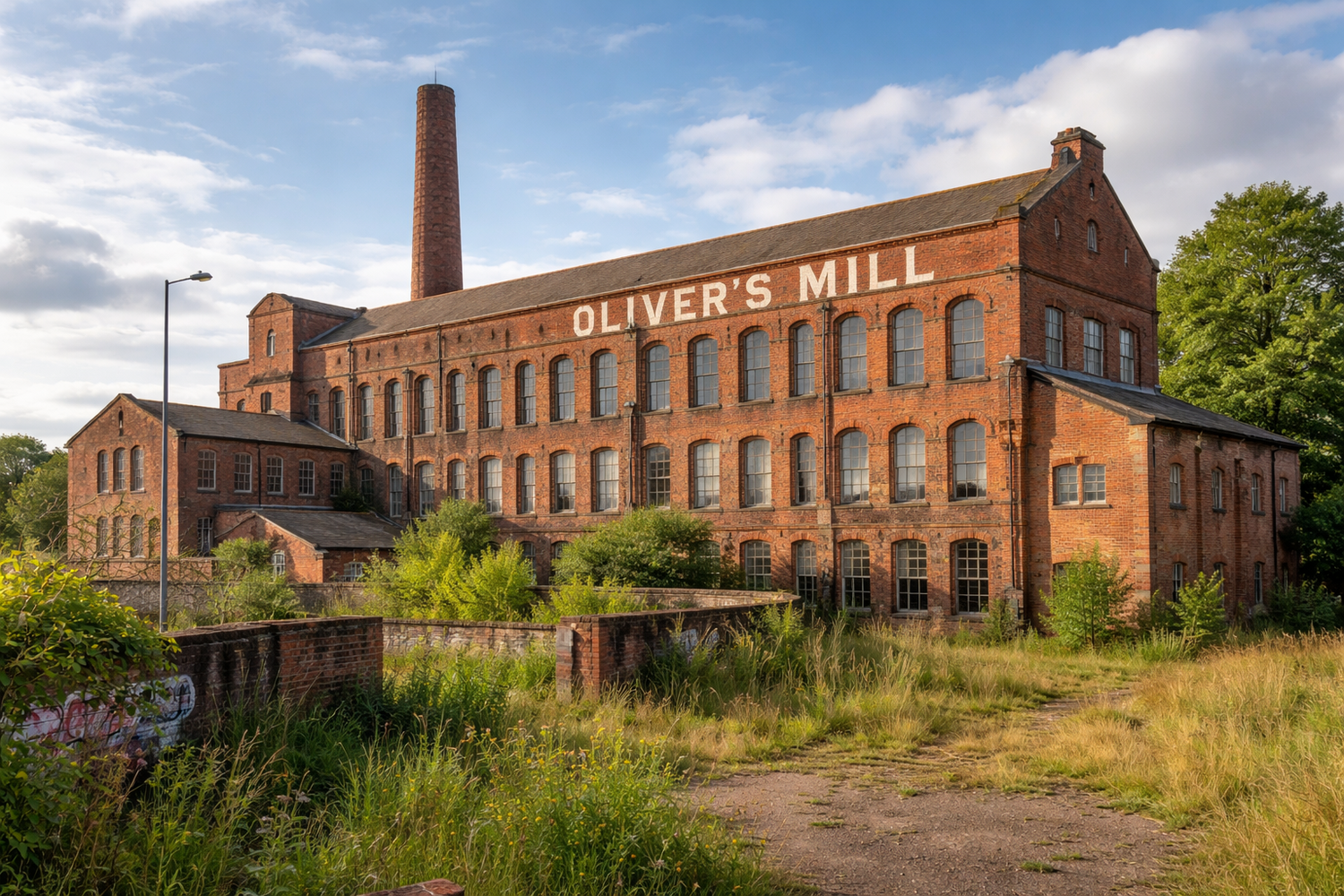
Oliver’s Mill is one of Stoke-on-Trent’s most significant surviving industrial heritage sites. Once a place of production and employment, the mill stands at the intersection of the city’s industrial past and its creative future. The Oliver’s Mill Feasibility and Development Programme, commissioned by the Teapot Factory and funded by the Architectural Heritage Fund, was led by Heritage Culture Communities (HCC) as Project Manager and Development Lead.
From Industrial Decline to Cultural Opportunity
The project began with recognition that Oliver’s Mill is not simply a redundant industrial structure, but a complex cultural asset with the potential to support creative production, community use, and heritage-led regeneration. Its scale, condition, and history required a strategic approach that balanced ambition with realism.
HCC’s role was to coordinate a feasibility process capable of addressing this complexity, ensuring that future proposals would be grounded in conservation best practice, viable governance models, and genuine public benefit.
Comprehensive Feasibility at City Scale
The programme brought together specialist heritage consultants, engineers, cost consultants, and development advisers to undertake a full feasibility assessment, including:
Conservation condition surveys and risk assessment
Options appraisal for phased redevelopment and adaptive reuse
Cost planning and financial modelling
Governance and ownership review
Early engagement with stakeholders and heritage networks
Alignment with local, regional, and national heritage priorities
Rather than prescribing a single solution, the process tested multiple future scenarios, recognising that large industrial sites often require incremental, phased development.
Culture-Led Development and the Role of the Teapot Factory
A defining strength of the project was the role of the Teapot Factory as client. As an established creative organisation rooted in Stoke-on-Trent’s cultural economy, the organisation brought deep understanding of artists’ needs, cultural production, and place-based working.
The feasibility explored how Oliver’s Mill could support:
Affordable creative and making spaces
Heritage interpretation and learning
Public access and community engagement
Long-term stewardship rooted in cultural use rather than speculative development
This culture-led approach ensured that heritage value and creative function were not treated as secondary to commercial considerations.
Early-Stage Engagement and Heritage Value
Although primarily a development-stage project, engagement was embedded within the process. Conversations with local stakeholders, heritage professionals, and cultural partners helped articulate the mill’s significance and potential role within Stoke-on-Trent’s wider heritage ecosystem.
This work aligned closely with the Architectural Heritage Fund’s emphasis on early-stage investment as a means of preventing loss, enabling sustainable reuse, and attracting future capital funding.
Governance, Sustainability, and Long-Term Vision
A critical element of the feasibility was governance and sustainability. HCC associate Andy Perkin worked with the client to explore models capable of managing a large industrial heritage asset over the long term, balancing creative use, public benefit, and financial resilience.
The resulting development framework provides a funder-ready, strategically robust foundation for future phases, ensuring that any subsequent investment builds on clear purpose rather than reactive decision-making.
A Platform for Future Investment
While the feasibility phase is underway, Oliver’s Mill stands as a platform for future regeneration, not a closed chapter. The work undertaken establishes a shared understanding of constraints, opportunities, and values — essential groundwork for any successful capital project.
For Stoke-on-Trent, Oliver’s Mill demonstrates how industrial heritage can be repositioned as an asset for contemporary culture, skills, and community life when development is rooted in place, expertise, and long-term thinking.
0 comments