

The Portland Inn Project: Artist-Led Regeneration and Community Ownership in Practice

A three-year capital redevelopment delivering far more than a building
Client: Portland Inn Project CIC
Funders:
Arts Council England
Community Ownership Fund
Stoke-on-Trent City Council
UK Shared Prosperity Fund
Project Management & Development: Heritage Culture Communities (HCC)
Project Duration: 3 years (Capital project)
Location: Cobridge
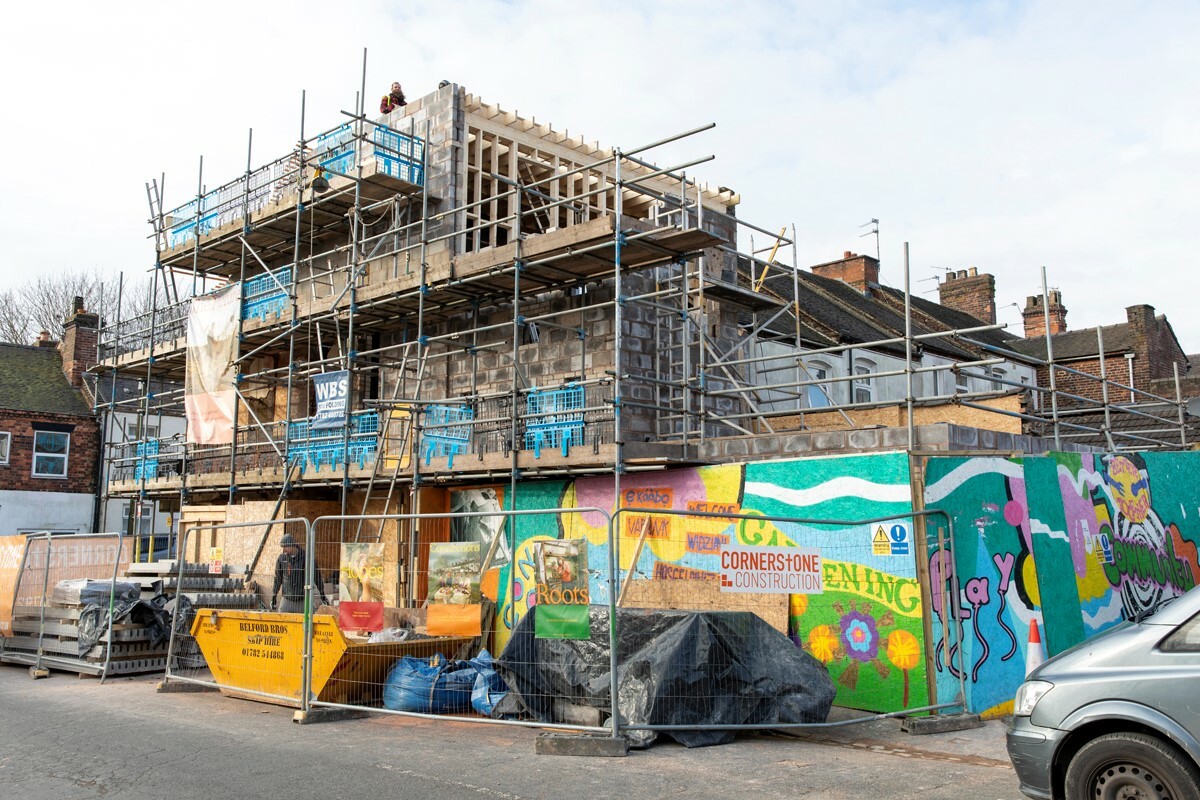
The Portland Inn Project is a complete capital redevelopment of the former Portland Inn pub in Cobridge, delivered over three years and led by an exceptional, artist-led client organisation. While formally a capital project, its impact far exceeds the physical transformation of a building, demonstrating a nationally relevant model of community-embedded, artist-led regeneration.
Full Capital Redevelopment with Community at the Core
The project involved the comprehensive redevelopment of a long-closed public house, returning it to active use as a community-owned, multi-functional cultural space. Works addressed the full scope of capital requirements necessary to bring the building back into sustainable use, supporting cultural production, community activity, and social infrastructure.
Crucially, capital delivery was never treated as an end in itself. From the outset, the Portland Inn Project approached redevelopment as a social, cultural, and democratic process, embedding community decision-making wherever possible within the constraints of governance, funder requirements, and delivery realities.
An Artist-Led Model of Best Practice
What distinguishes the Portland Inn Project nationally is its artist-led approach. The Portland Inn Project is spearheaded by Artists and Dirctors Anna Franci and Rebeccas Davies. Artists were not brought in to “animate” a finished building; they were integral to shaping how decisions were made, who was involved, and what values underpinned the project.
This model prioritised:
Deep listening and responsiveness to community need
Iterative co-design rather than fixed masterplans
Transparency about constraints and trade-offs
Creative methods to enable participation and dialogue
As a result, community members were not merely consulted but actively involved in shaping the space’s purpose, governance, and programming.
Exceptional Client Practice and Community Responsiveness
The Portland Inn Project client demonstrated an unusually high level of responsiveness, reflexivity, and trust-building. Engagement was ongoing, adaptive, and genuinely influential, enabling local people to see how their input shaped outcomes.
Decision-making was shared wherever possible, with clear communication where it was not. This honesty strengthened confidence and avoided the disengagement often associated with consultation-heavy regeneration projects.
Funding as an Integrated Ecosystem
The project brought together a complex funding mix:
Arts Council England supported the cultural and artistic vision
Community Ownership Fund enabled long-term community stewardship
Stoke-on-Trent City Council supported local regeneration priorities
UK Shared Prosperity Fund aligned the project with inclusive growth
HCC’s role as Project Manager was to coordinate delivery across this ecosystem while protecting the project’s core values and community focus.
National Recognition and Sector Relevance
The Portland Inn Project has attracted national attention as an example of best practice, including coverage in national media and sector discussion around artist-led regeneration and community ownership. Its relevance extends beyond Stoke-on-Trent, offering a replicable model for towns and cities seeking alternatives to extractive or top-down redevelopment.
A Living Civic Asset
The Portland Inn will stand as a living civic space—supporting culture, creativity, and community life in Cobridge. It demonstrates that when artists are trusted as leaders, and communities are treated as decision-makers rather than audiences, capital projects can deliver lasting cultural and social value.
For Stoke-on-Trent, the project represents a powerful example of what locally rooted, values-led regeneration can achieve.
0 comments